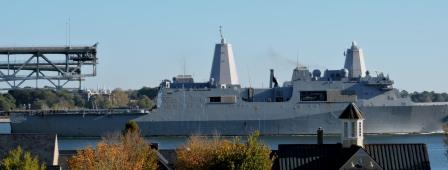
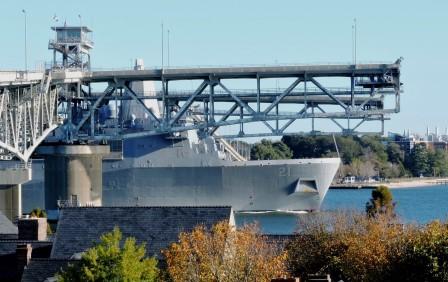
Seen alone or in profile, all Navy ships look big. When seen while transiting the Coleman Bridge at Yorktown, the differences become acute.
Here is the passage this week of the USS Mesa Verde, a San Antonio-class landing ship dock. It’s used to land a battalion of 800 Marines and assorted tanks and helicopters on enemy beaches.
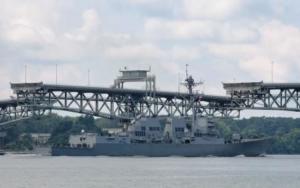 The vertical profile is less than that of a guided missile cruiser, whose radio antennae extend well above the top of the Coleman Bridge, by 20 feet or so. The top of the Mesa Verde barely is visible at bridge level. That hardly means it could go under the bridge, since there’s another 30 feet of bridge in the way.
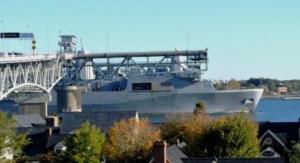 The horizontal profile tells the story. The Mesa Verde displaces more than 24,000 tons while the cruiser displaces 9,000 tons. The lengths are 684 feet vs. 505. The beams are 105 feet and 65 feet, respectively. Clearly the Mesa Verde is a big ship, roughly twice as big as the cruiser. As a result, its top speed is 22 knots vs. 30 knots for the cruiser. But the cruiser is still the taller ship.
Still behind in port at Naval Weapons this week was an unidentified Navy submarine, whose specs are off the charts compared to the two surface ships.
Let’s Go Sail
Check rates and pick a day for a sailboat charter. See reviews on Trip Advisor.