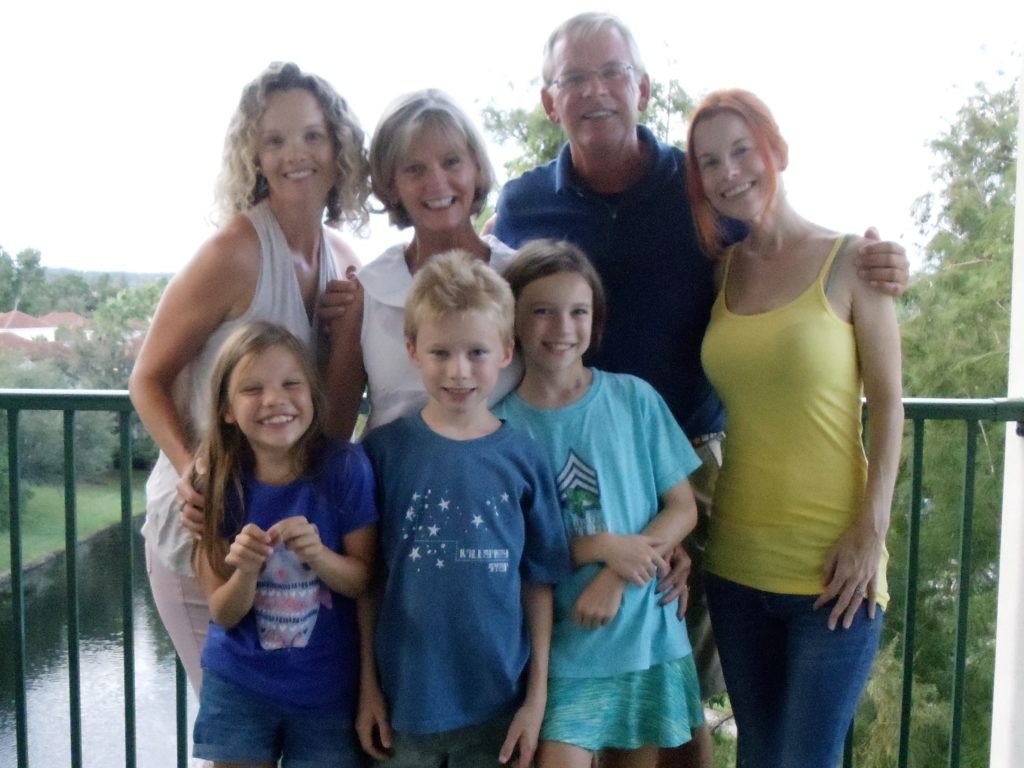
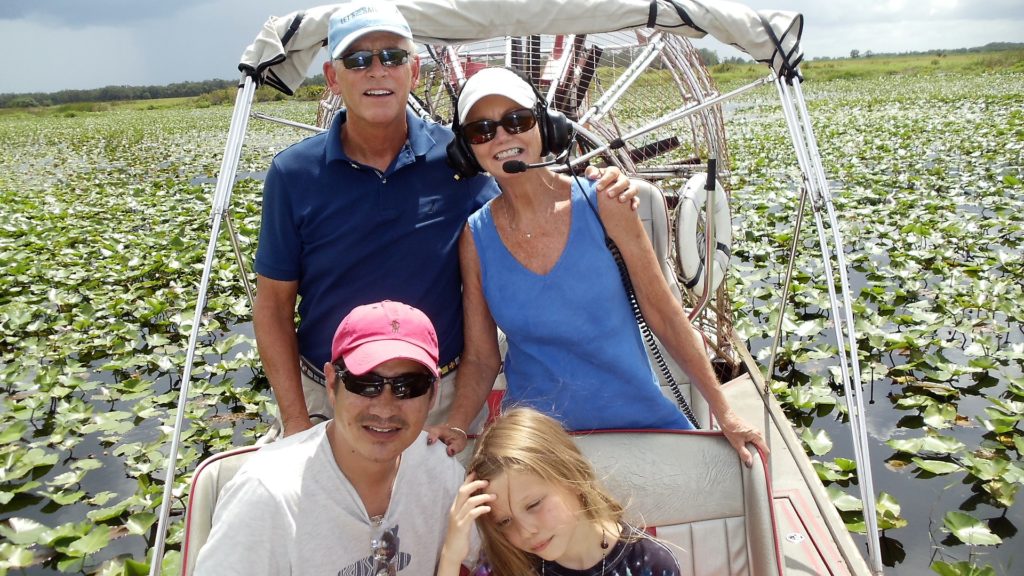
Of all the boating our family has enjoyed over the years, we have never gone on an airboat. While on vacation in Florida, our son-in-law Trevor Phillips booked us for a unique and private two-hour adventure tour of the marshy shores around Lake Tohoperaliga near Orlando. Trevor knows how much we enjoy boating.
 “We call it Lake Toho,” said our Capt. Chris Miller, who’s been skippering here in Orlando for two years. “The lake is 18 square miles, and we’ll see a lot of it as we dodge between storms.” With headsets in place to muffle the noise of a 460 hp Cadillac engine, we zoomed down a canal and broke out across a lily pond with grass. My first reaction was that we would run aground, but of course that was less likely since the engine power was over the water and not under it.
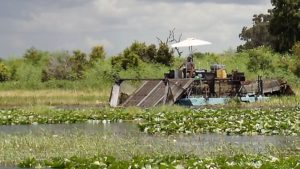 The first (and only) sign of human life was an odd machine seemingly scooping up water. Capt. Chris said, “He’s a farmer trying to cut a path through the water. We had 19 days straight of rain, and the water is as much as two feet higher than normal.”
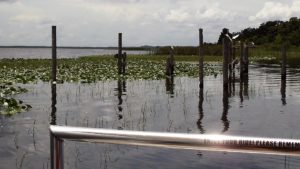 Next, we cut inland and slowly passed through a set of broken wood piers and slats. “This used to be a dock,” he said. We plowed through acres of marsh with only a little water below. We saw egrets and blue heron and more.
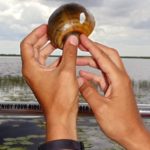
Chris found a snail shell and fished it out of the water for us to keep. You could see a hole in it where another animal got the snail, probably an alligator.
Farther into the lake, Chris stopped at a little island in the water. “This is an alligator nest, floating. She cut out the island and has a little outlet to go out and find small fish for her and her babies. She’s very protective, and this inlet is the only way a predator can get in.”
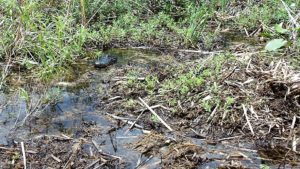 We could see the alligator’s head sticking up from the muck, but that’s all. Chris said the body extended six feet under water. “The tall grasses are just that,” with pods of seeds inside them. We zoomed off through the lily pads and grass to another alligator nest, and then another. After a while I
  wondered if it wasn’t the same nest over and over.
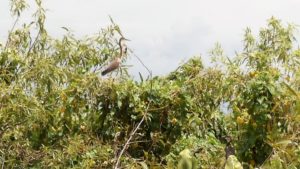
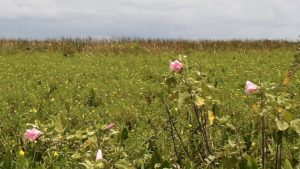
Then we arrived at a bigger spot with veritable trees. “It’s an island that has grown up and become a haven for all sorts of birds,” Chris said. Nearby, flowers bloomed fully in the watery pastures.
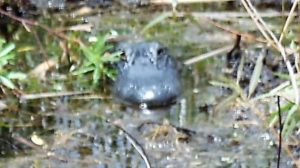 I asked about the difference between an alligator and a crocodile, and I was surprised how simple the distinction is. “Alligators are found in fresh water, crocodiles in saltwater. Beyond that, crocodiles get bigger and certainly wider.”
Chris stopped at another tree-like grove and asked our granddaughter Willa, “What do you call an alligator with a vest? An investigator.” We moved along and he asked, “What do you call an alligator with a GPS? A navigator.” We proceeded on and he asked, “What do you call a cow in the water? A cow in the water.”
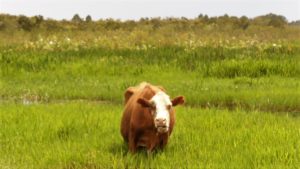 Sure enough, there she was, all alone eating grass. That was a great comedic set-up. “The cow is damaged on the right side of her head, perhaps from an alligator attack,” Chris said. She looked pretty good, and pretty comfortable.
With our tour nearly over, Chris showed us clever moves with the airboat as he swerved from side to side and did tight circles. Then he managed to zoom over hard ground, which was lumpy but speedy. Soon he ran out of options to avoid the third storm of the afternoon, and we headed in to beat a big thunderstorm.
Soaring Into Space
Our daughter Wendy and I took all three grandchildren to the Kennedy Space Center, a sprawling expanse of 219 square miles made famous by the original Mercury launches and later the Apollo moon shots. Bonnie and I first attended years ago during the week that Sally Ride went up as the first woman in space.
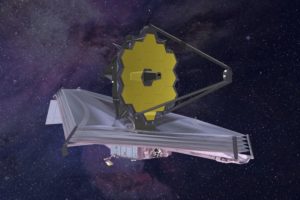 Perhaps the most amazing thing we saw was a 3-D show about the future of space, as determined by the next generation of the Hubble Space Telescope. The James Webb Space Telescope will launch next year as many times more powerful. Whereas the Hubble could pick out a car from space, the Webb can identify the car’s Engine Oil light on the dashboard. The narrator showed us a blurry tiny dot on a vast screen and said it represented an entire galaxy. By viewing thousands of galaxies through the Webb scope, he said we’ll be able to detect if any of them have lights, ergo life. I asked afterword what he means by lights, and he said lightening or aurora borealis. “Or life?” I asked. “Maybe,” he said.
The short history of the early days of Kennedy Space projects consists of Mercury, Gemini, Apollo. Mercury comprised the original seven astronauts and the first man in space (Shepard). Gemini comprised ten manned missions with many of them orbiting Earth. Apollo took us to the moon.
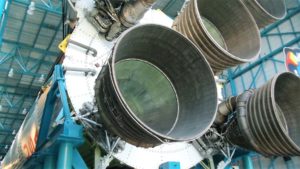 Increasingly these led to the Saturn V rocket, the most powerful ever and said to hold the equivalent of an atom bomb. When NASA switched gears to the Space Shuttle program, it had a leftover Saturn V that was never used. Today it fills a cavernous building and includes the multiple stages and all their hook-ups. It is a massive enterprise whose firing requires 300,000 gallons of water flooding the launch pad in just 20 seconds at takeoff to absorb the heat and noise of ignition and thus avoid any damage to the spacecraft.
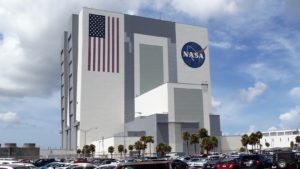 We took an extensive bus tour around the compound and saw where Boeing and Space X are using Kennedy Space Center for their ventures into space. Our narrator assured us it was not a race with NASA. I turned to Wendy and said, “Right.” We saw the half-mile stretch from the Vehicle Assembly Building to Launch Pads A and B where missiles of yore and tomorrow are fired.
At the origin, the iconic Assembly Building is said to be the largest in the world “by volume,” 3-1/2 times bigger than the Empire State Building. A giant American flag adorns the front of the building along with the NASA logo. The blue field in the flag is the size of an NBA basketball court. Today the building is undergoing retrofit for the Orion series of launches to Mars and beyond. From here launched all 12 Apollo rockets during 1967-73 and 135 Space Shuttles 1981-2011.
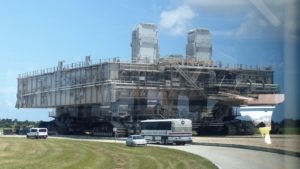 The rockets were transported at 1 mph by a giant platform on tank treads that virtually crush the stones in the pathway. We passed close by in the bus to see it up close. It must weigh thousands of tons.
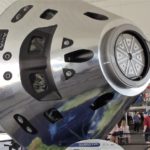 The Mars spacecraft is named Orion and is three times the size of the original Mercury capsule, owing to the considerably longer journey of months instead of minutes. The first launch is scheduled next year. I looked at the space capsule for a long time while sitting at benches eating lunch. I hoped they test the astronauts for claustrophobia.
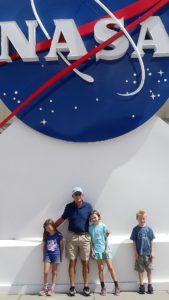 Wendy adroitly noted that the narrations all day had a recruitment overtone, not just to kids to become astronauts but to parents to support the space program in general through our taxes. To that end, the space shots were credited with all manner of spinoffs that have led to technological and medical improvements in American society. That began not with Tang, but the semiconductor chip which reduced electronics to a size and weight for space travel.
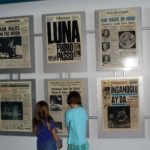 The museum tour included a wall of newspaper front pages from all over the world heralding the moon landing of 1968. The biggest was LUNA by an Italian newspaper. Those were the days.
Our grandson Ivan has had a keen interest in space, but on this day I was the kid in the candy store. Having grown up during the Mercury program, I identified closely with the missions and ambitions of the space program. As family reunions go, this one was A Okay in the words of Alan Shepard in 1961.
Let’s Go Sail
Check rates and pick a day for a sailboat charter. See reviews on Trip Advisor.